

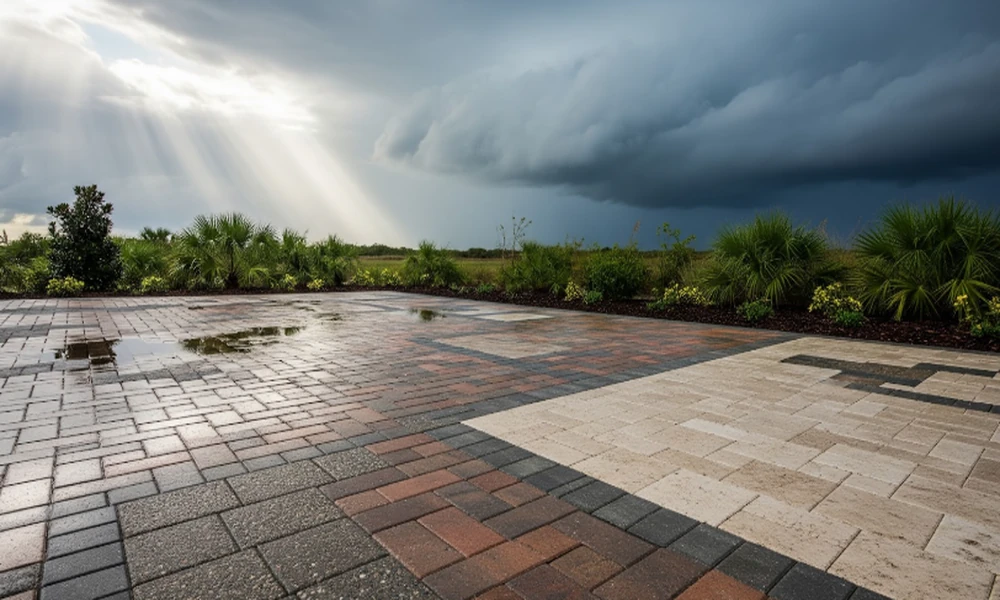
Forty inches of rain. Ninety degree afternoons that don’t quit until October. Air so salty your patio furniture starts rusting by year two. If you’ve ever priced a paver job anywhere between Miami and Naples, you’ve probably heard that limestone turns to mush in that kind of weather. That’s a half truth at best, and it’s costing people good patios.
I’ve watched homeowners walk past a pallet of limestone because a neighbor swore it stains, then pay twice as much for a concrete product that cracks in three summers. The truth sits somewhere less dramatic. Limestone pavers South Florida homeowners actually install, the dense ones sourced properly, handle our climate about as well as any natural stone you can buy. The cheap stuff from a big box pallet is the problem, not the stone itself.
Here’s what this covers: how limestone behaves in our specific climate, which types hold up, how to tell good stone from bad before you buy, and a maintenance routine that keeps it looking sharp for decades. If you’re sourcing stone for a residential or commercial job, limestone pavers South Florida buyers choose are typically quarried for density and salt tolerance rather than the softer grades sold in cooler markets.
Why limestone acts differently in humid, salty air
Limestone is sedimentary rock, mostly calcium carbonate, formed from compressed marine deposits. That origin story matters because it explains two things: why limestone looks the way it does, and why it reacts the way it does to water and acid.
According to the U.S. Geological Survey, limestone forms primarily from the accumulation of shell, coral, and algal debris, which is why color and hardness vary so much from one quarry to the next. Some limestone is dense enough to ring when you tap it. Some crumbles if you look at it wrong.
In South Florida, three forces do all the damage:
- Rain volume. Our wet season dumps water fast. Stone that doesn’t drain well stays saturated for days.
- Salt air. Coastal properties see constant salt exposure, which accelerates surface wear on porous stone.
- Heat cycling. Stone expands in afternoon sun and contracts at night. Porous stone cracks along those stress lines.
Dense limestone shrugs most of this off. Porous limestone doesn’t. And here’s the part most showroom salespeople gloss over: you can’t tell the difference by looking. You have to ask about density, absorption rate, and where it was quarried.
Which limestone types actually belong on a Florida patio
Not all limestone is the same product, even when the labels look identical. Here’s how I’d rank them for our climate.
| Limestone type | Climate fit | Best use |
|---|---|---|
| Coralina (coral limestone) | Excellent | Pool decks, patios, walkways |
| Oolite stone | Excellent | Driveways, pool surrounds |
| Hemingway flagstone | Good | Garden paths, accent areas |
| Soft imported limestone | Poor | Skip it for exteriors |
Coralina and oolite are the two I’d put my own money on. Both are quarried close to home, both are dense, and both have been used in Florida construction long enough that we know exactly how they age. Hemingway flagstone is gorgeous, but the irregular surface holds more moisture, so it’s better for paths than for a pool deck you’re barefoot on every day.
The duds are usually imported stones meant for indoor flooring in drier climates. They’re cheaper per square foot, and they look fantastic in a showroom. Two wet seasons in, they’re flaking.
How to read a pallet before you buy
You don’t need a geology degree to spot weak stone. You need ten minutes, a water bottle, and a willingness to annoy the salesperson.
- Pour water on the surface. If it beads slightly and sits, the stone is dense. If it drinks the water in seconds, that’s porosity you’ll fight forever.
- Ask for the absorption rate. Anything under 3 percent is a solid exterior candidate. Reputable suppliers know this number off the top of their head.
- Check thickness consistency. Uneven thickness means an uneven patio and a grout line that fails early.
- Look at the quarry origin. Florida quarried stone is your safest bet for our climate, plain and simple.
- Confirm it’s rated for exterior use. Get it in writing. “It should be fine” is not a rating.
I’d walk away from any supplier who dodges the absorption question. That’s my personal line, and I’ve never regretted it.
Sealing: the step most homeowners skip
A penetrating sealer is the difference between a patio that looks new in year eight and one that’s gray and chalky by year four. Penetrating sealers soak into the stone and block water from the inside. Topical sealers sit on the surface and wear off in the sun, so skip those for exterior stone.
Seal once when the stone is installed and dry, then reapply every two to three years. In coastal Broward or Miami-Dade, lean toward every two. Salt exposure is relentless there, and sealers break down faster in direct sun. It’s a weekend chore with a roller, not a project. Worth it, every time.
What limestone maintenance actually looks like
Less than you’d think. Sweep or rinse the surface weekly. Rinse away salt spray on coastal properties about as often as you’d water your plants. Skip acidic cleaners entirely, because acid etches calcium carbonate, and you’ll never buff that damage out.
For stains, a mild dish soap and water with a soft brush handles nearly everything. Mildew in shaded spots? Diluted oxygen bleach, then rinse. That’s the whole routine.
For commercial properties, factor the maintenance into your operating budget from the start.
The Bureau of Labor Statistics tracks landscaping and groundskeeping as a sizable segment of the national workforce, which tells you maintaining outdoor surfaces is a real recurring cost, not a one time line item. Planning for it beats getting surprised by it.
When limestone is the wrong call
There are jobs where I’d steer a client elsewhere. Steep driveways where heavy trucks turn constantly. Areas with standing water and zero drainage. Extremely tight budgets where the only affordable limestone is the soft imported grade.
For those, concrete pavers or travertine might serve you better. But for the typical South Florida patio, pool deck, or walkway, limestone wins on looks, longevity, and the way it stays cool underfoot in August. Florida’s own road construction relies heavily on limestone aggregate, according to the Florida Department of Transportation, so it’s fair to say the material is native to our built environment, not a trend.
My rule: match the stone to the climate, then seal it, then stop worrying about it.
Pick stone once, enjoy it for decades
Limestone isn’t fragile. Cheap limestone is. Get the density right, ask the questions most buyers skip, and seal the surface on schedule, and you’ll have a patio that outlasts the fence around it. The real failure point in most South Florida limestone projects was never the stone. It was a rushed purchase from a supplier who wouldn’t talk about absorption rates.
So before you sign anything, ask one question: where was this stone quarried, and what’s the absorption rate? If the answer is clear and specific, you’re in good shape.
